





The stretch between 23-month-old milestones and those of a full 2-year-old often feels like one of the biggest leaps you’ve seen so far or can take you by surprise with how quickly things change. One day your toddler is wobbling up the stairs with both hands gripping the rail, and the next they’re insisting, “Me do it!” with surprising confidence.
This is a season where little ones are caught between babyhood and childhood — a phase full of curiosity, independence, and a few dramatic tantrums along the way. At 24 months, many children start talking in short bursts, notice more about the people around them, and move with new steadiness.
You might notice new words appearing overnight, pretend play drawn from daily routines, or block towers reaching impressive heights. 2-year-old milestones are better seen as rough markers — not a finish line every child must cross at the same time — what matters is your toddler finding more words, moving with more confidence, and showing more of who they are.
This is a season where little ones are caught between babyhood and childhood — a phase full of curiosity, independence, and a few dramatic tantrums along the way. At 24 months, many children start talking in short bursts, notice more about the people around them, and move with new steadiness.
You might notice new words appearing overnight, pretend play drawn from daily routines, or block towers reaching impressive heights. 2-year-old milestones are better seen as rough markers — not a finish line every child must cross at the same time — what matters is your toddler finding more words, moving with more confidence, and showing more of who they are.
From steps to jumps: physical development at 23–24 months
By the time your child turns two, movement is everywhere. The wobbly, wide-legged walks of babyhood are mostly gone. In their place is a toddler who dashes across the living room before you can grab their shoes, or who insists on climbing the stairs with the focus of a mountain hiker.
At 23 months, motor skills are already showing off: deep squats to grab toys, pulling things along while walking, or bouncing into the air with both feet (even if it’s barely an inch off the ground). These toddler motor skills at 23 months are practice runs for the bigger moves that follow.
What about 24 months? Things get even bolder — climbing stairs one step at a time, stretching on tiptoes to swipe something off the counter, or bouncing in place with pure joy. Their hands are busy too: stacking four or more blocks into wobbly towers, flipping book pages faster than you can read, scribbling across paper, or stabbing at food with a spoon that only sometimes makes it to their mouth.
Every one of these attempts — a collapsed tower, a page turned upside down, a spoonful that misses — builds strength and confidence. Progress at this age doesn’t look polished, but it’s relentless.
2 years on the move: how toddlers run, climb, and jump
As the second birthday approaches, you may feel like your toddler is in motion from dawn till bedtime. You can’t help but wonder — where do they get all that energy? But at 23 months, their run has purpose — less stumble, more dash — and squatting mid-play no longer sends them tumbling. Climbing becomes their obsession — couches, playground steps, and, yes, the places you’d rather they leave alone.
By age two, many toddlers tackle the stairs one careful step at a time, clutching the railing or your hand — unless they shake you off to prove they can do it alone. Jumping starts as a little bounce, hardly off the floor, but their face glows like they’ve taken flight.
Small hands, big experiments — fine motor skills at two
Life at two is one long experiment. A spoonful of yogurt might actually reach the mouth, a fork makes brave stabs at peas, and sleeves are tugged on with the stubborn focus of a toddler who refuses help.
Their curiosity shows up everywhere: blocks piled high before toppling, pages turned so fast you barely get a sentence in, crayons racing across paper (and sometimes walls), stickers peeled slowly, with total concentration, as if nothing else in the world exists.
Finding their voice: speech and language at 2 years
By the time toddlers near two, their chatter suddenly feels like actual words, not just babble. At 23 months, you might hear a growing stash of 50–100 words — the everyday must-haves like mama, ball, milk. Soon, they start stringing them together: “more juice,” “mama go.” Short, to the point, but suddenly very clear.
By 24 months, words pile up quickly — often past 200, with three-word sentences tumbling out — “I want a toy,” “me go outside.” The real shift isn’t how many words they say, but that they’re finally telling you what they think and feel.
Boosting language and speech
Talk, read, and sing. Name objects during routines, expand on their words (“car” → “Yes, a red car”), and read picture books daily. Songs and rhymes make words catchy and easier to copy. Even chatting about what you’re cooking or spotting on a walk slips in new words without effort.
More than words: toddler gestures and early communication.
Before sentences, there are gestures: a wave goodbye, a nod for yes, a blown kiss, a wave, a nod — tiny gestures that carry a lot of meaning. By two, that pointing finger gets a workout — at snacks, toys, or pictures in a book — proof they understand and want to share.
Often, gestures pair with speech — a finger at a cup with “juice,” or a puff of air with “hot.” Gestures stick around even as words grow, filling the gaps when speech lags.
Social and emotional development
Life with a two-year-old swings between toy-grabbing ‘mine!’ and surprising moments of tenderness. One minute they’re in full tantrum mode, the next they’re pausing to comfort a crying friend. Those sharp mood swings are part of how toddlers sort out their feelings — independence clashing with emotions that still feel too big to handle.
Tantrums and independence
What we call the ‘Terrible Twos’ is really your toddler testing out what being in charge feels like. Saying “no,” resisting routines, and demanding to “do it myself” are all part of toddler independence at 2. Over time tantrums shrink as words grow, leaving behind a more self-assured little person.
Parallel play and pretend play
At this age, toddlers’d rather sit shoulder-to-shoulder than actually share toys — stacking blocks in parallel or running laps on the same playground. The parallel play is the early stage of learning how to be with friends.
Pretend play sparks too: dolls get rocked, toy pots stirred, boxes turned into cars. In these early games where imagination takes off, toddlers solve problems their own way.
Sleep battles with a 2-year-old and picky plates
Two-year-olds love to skip naps, save their energy for bedtime, and turn peas into flying objects. Sure, they need 12–13 hours of sleep, but try telling that to a kid who thinks bedtime is a negotiation worthy of a high-level summit.
The afternoon nap you counted on can vanish suddenly, making you wonder if the 23-month sleep regression is real after all. Often their mind is too busy with new tricks to settle down — too many new skills to practice, too much energy to settle down. A steady sleep routine helps, even if naps get skipped here and there.
Mealtimes get theatrical too. Growth slows, appetite dips, and yesterday’s favorite pasta is suddenly pushed away. Picky eating usually isn’t about taste at all — it’s about power. Saying ‘no’ just because they can. Offer healthy options, skip the battles — toddlers often return to foods once the thrill of refusal wears off.
Whether at bedtime or mealtime, toddlers love testing who’s in charge — and in their view, it’s them. It’s messy, sometimes maddening, but every stubborn ‘no’ is one more step toward becoming their own little self.
Development checklist for 24 months
Every toddler runs on their own timeline, but knowing the usual milestones helps you spot the little changes that show how much they’re growing. This 23–24 month toddler development checklist highlights the skills most little ones are tackling around their second birthday. It’s not a test — more like a snapshot of what most toddlers are trying out at this age.
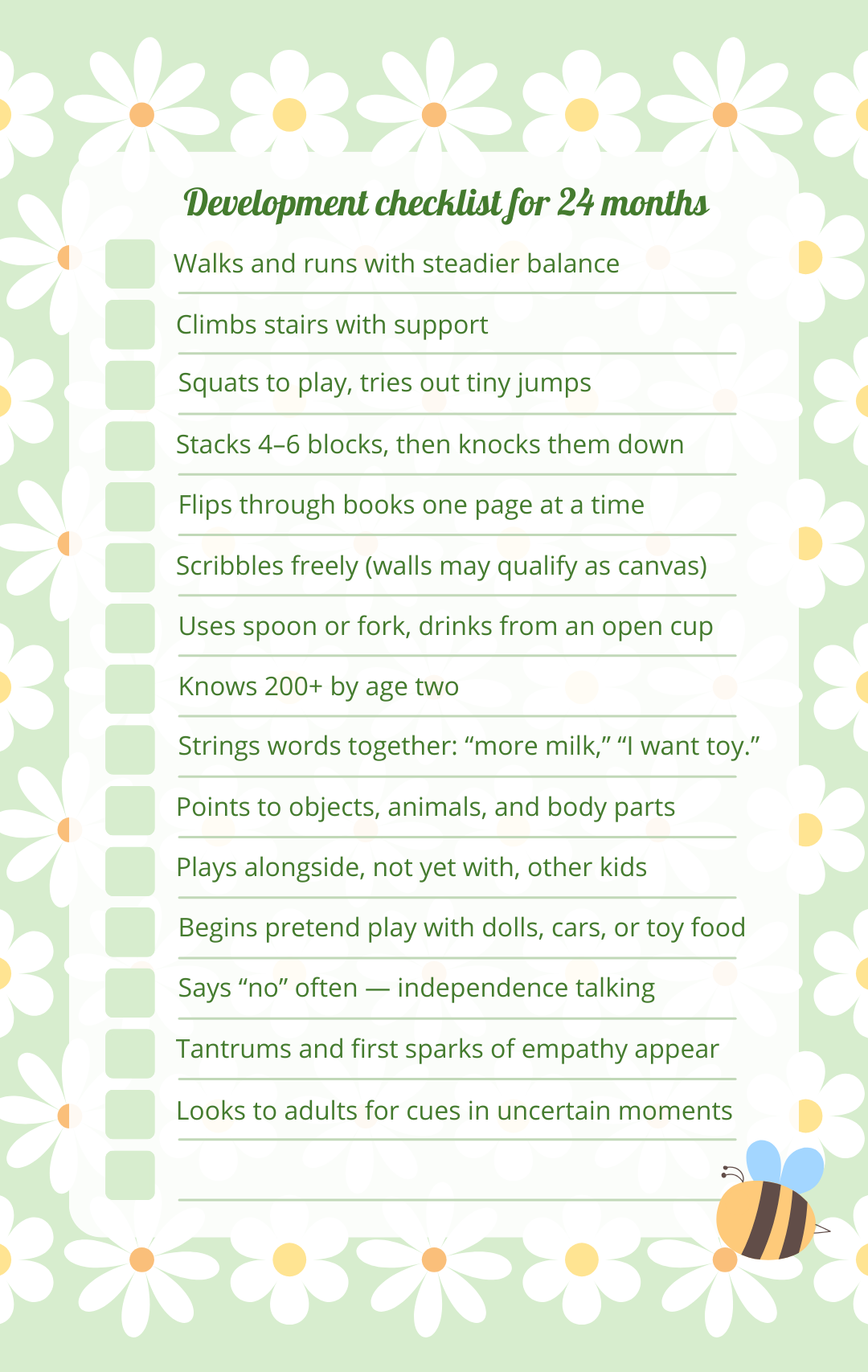
Not every child will check off each box at exactly the same time. What matters most is steady progress over weeks and months. If you have concerns about your toddler’s development, it’s always a good idea to talk with your pediatrician.
Milestone red flags to discuss with a pediatrician
Every toddler grows in their own rhythm, and small variations are almost always normal. Still, there are moments when paying closer attention can be helpful. Specialists often call these toddler milestones “red flags” — not because they guarantee something is wrong, but because they’re signs worth bringing up with your pediatrician.
If a child isn’t walking on their own, speaks fewer than 15–20 words, avoids pretend play, or rarely seeks eye contact, it may be worth a conversation with your pediatrician. The same goes for toddlers who consistently walk on tiptoes or don’t follow simple directions.
Seeing one of these signs doesn’t automatically mean something is wrong — it just means it’s worth a closer look. Checking in early can ease your mind and, if support is needed, make sure your toddler gets the support they need early. Most importantly, trust yourself. You know your child better than anyone, and if something feels off, it’s always worth sharing.